At Korea-ASEAN summit, Lee says Seoul shares the bloc's vision for 2045, vows to be 'reliable action partner'
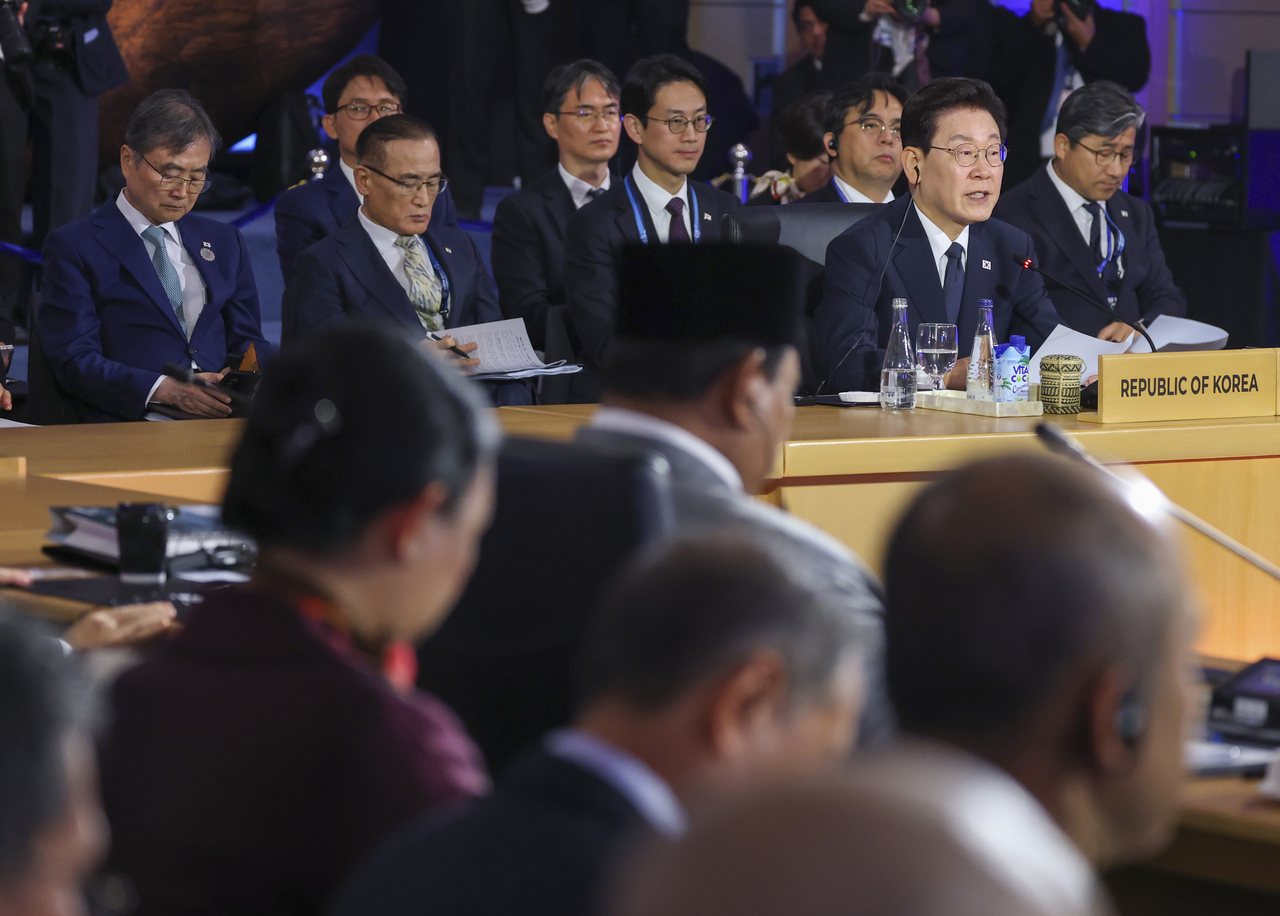
MANILA, Philippines — President Lee Jae Myung called for greater solidarity between South Korea and Southeast Asia, amid mounting geopolitical tensions and economic uncertainty, vowing that Seoul would be a "reliable action partner" in helping realize the regional bloc's 20-year vision.
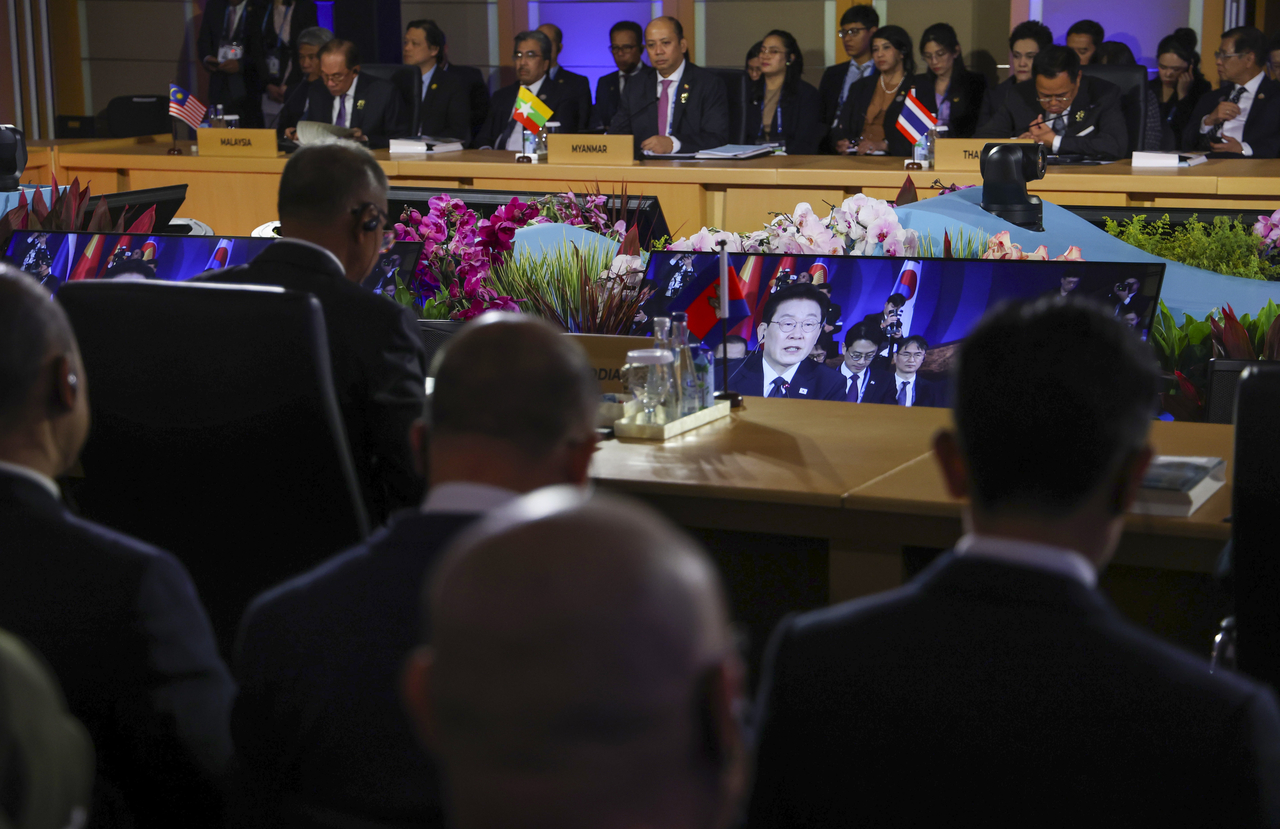
Lee made the remarks at a summit between South Korea and the Association of Southeast Asian Nations, an 11-member regional bloc, shortly after arriving in the Philippines' capital Manila earlier Monday.
"Amid growing uncertainty in the international landscape, ASEAN's role as the central pillar of regional cooperation is becoming more important than ever," Lee said in his opening remarks.
"In this time of deepening geopolitical conflicts and growing economic uncertainty, it is all the more important for the Republic of Korea and ASEAN to enhance their solidarity," he added, referring to South Korea by its official name.
Lee's second appearance at the annual Korea-ASEAN summit since taking office in June 2025 comes as the two sides grapple with mounting economic and security challenges, including disruptions to global energy supplies and trade routes stemming from the war involving the United States and Iran.
The conflict has disrupted shipping through the Strait of Hormuz, driving up energy and transportation costs and raising concerns about food security across Asia, where South Korea and ASEAN economies are closely linked through trade, manufacturing and supply chains.
Speaking at the summit, Lee pledged to support ASEAN Community Vision 2045, a 20-year development blueprint adopted in May 2025 that aims to transform Southeast Asia into an epicenter of growth in the Indo-Pacific by 2045.
"The ASEAN Community Vision 2045 — which envisions a resilient, innovative, dynamic and people-centered ASEAN — is not just an ASEAN goal; it is a future that the Republic of Korea also hopes to help usher in," Lee said. "To help realize this vision, the Republic of Korea will be a reliable action partner."
Lee also reaffirmed Seoul's support for ASEAN's central role in shaping regional affairs, a principle known as ASEAN Centrality, under which the bloc seeks to remain a driving force in regional dialogue and cooperation.
"The Republic of Korea firmly supports ASEAN Centrality," Lee said. "As envisioned in the ASEAN Outlook on the Indo-Pacific, we will continue to actively promote open and inclusive regional cooperation."
Lee further acknowledged ASEAN's contribution to efforts to maintain peace on the Korean Peninsula.
"The Republic of Korea appreciates ASEAN's role as a key partner in promoting lasting peace and stability on the Korean Peninsula," Lee said.
Turning partnership into action
Beyond the broader diplomatic pledges, Lee highlighted progress under his ASEAN-ROK CSP Vision, unveiled at last year's summit to ensure that the two sides' Comprehensive Strategic Partnership would "deliver tangible benefits to the people of all our nations."
South Korea and ASEAN elevated their relationship to a Comprehensive Strategic Partnership in October 2024, the highest level of partnership ASEAN accords its dialogue partners, marking the 35th anniversary of their dialogue relations.
Building on that diplomatic framework, Lee's CSP Vision sets out three goals under the same initials — contributor, springboard and partner — aimed at expanding people-to-people exchanges, boosting economic cooperation and strengthening regional security ties.
At the summit, Lee further underlined that the vision had begun yielding concrete results over the past year, singling out efforts to combat transnational crime as a particular priority.
Among the initiatives is the Korea-ASEAN Response and Enforcement against Scam-Related Crime, or KARE, a project linking South Korea's National Police Agency with ASEANAPOL, the regional police cooperation organization, to tackle cross-border online scams and fraud.
Another initiative, the Korea-ASEAN Maritime Safety Academy Project, or KAMSA, aims to strengthen maritime safety capabilities through cooperation between the Korea Coast Guard and its Southeast Asian counterparts.
"From cyberspace to the seas, Korea and ASEAN will work together to safeguard our peoples' lives and security," Lee said.
On trade, Lee pointed to ongoing negotiations to upgrade the ASEAN-Korea Free Trade Agreement as another sign of progress.
The two sides agreed in October 2025 to pursue an upgrade of the agreement and held their first formal round of negotiations in Seoul in June this year. The talks cover 13 areas, including digital trade, critical minerals and supply chains, as both sides seek to adapt their trade arrangements to a changing global economy.
"By proactively responding to the changing global trade environment, we will work toward achieving annual bilateral trade of $300 billion," Lee said.
Lee also made formal proposals for the leaders' Level 2 initiatives — the ASEAN-ROK AI Companionship Initiative and the ASEAN-ROK Cultural and Creative Industries Initiative — though he did not provide further details.
"The Republic of Korea will lead the way in ensuring that everyone shares in the benefits of AI advances and that the cultural creativity of ASEAN's young people leads to new opportunities."
Philippine President Ferdinand Marcos Jr., who chaired the summit, echoed Lee's call for closer cooperation.
"Amid strategic uncertainty, rapid technological change and cross-border challenges, our partnership has never been more relevant," Marcos said. "Our deep-rooted ties are reflected not only in our shared strategic goals, but also in the vibrant people-to-people connections across our region."
dagyumji@heraldcorp.com